CostMaxx
Coding agents burn context on tool output they barely use: thousand-line test runs for three failing tests, full diffs for a rename, complete build logs for one error. CostMaxx returns a compact summary and keeps the full evidence locally, retrievable by digest.
Role and process
Role: Systems engineer and agent tooling builder
Challenge: Coding agents burn tokens on tool output they barely use: thousand-line test runs for three failing tests, full diffs for a rename, complete build logs for one error.
- Return only the signal the model needs: pass/fail counts, failing test names, duration.
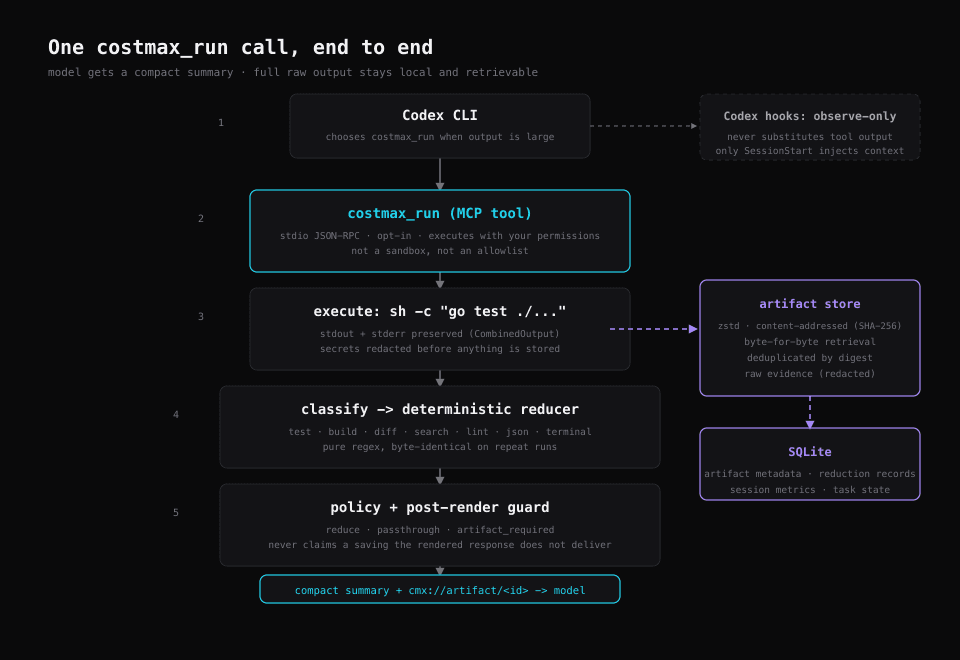
- Keep full output local, zstd-compressed and content-addressed — nothing leaves the machine.
- Hooks are observe-only; the model must call costmax_run explicitly.
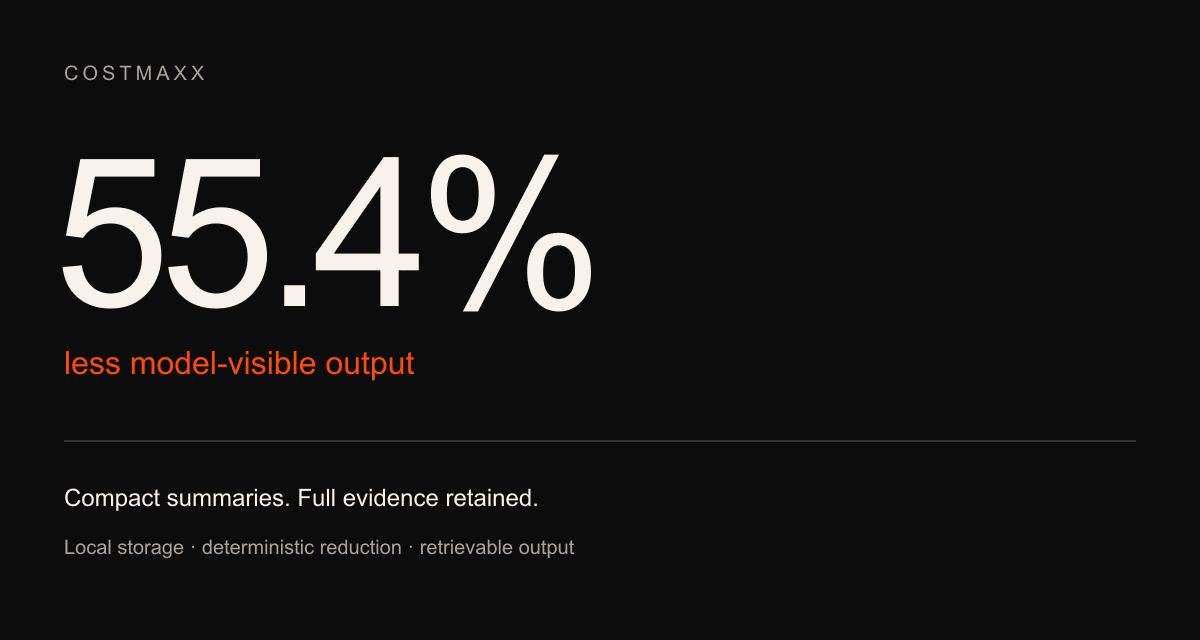
Output reduction: 55.4% · Answers preserved: 60 of 60 · Raw output: Kept locally
Tools: Go, MCP, CLI tooling, SQLite, Deterministic reduction, Token efficiency
The context problem
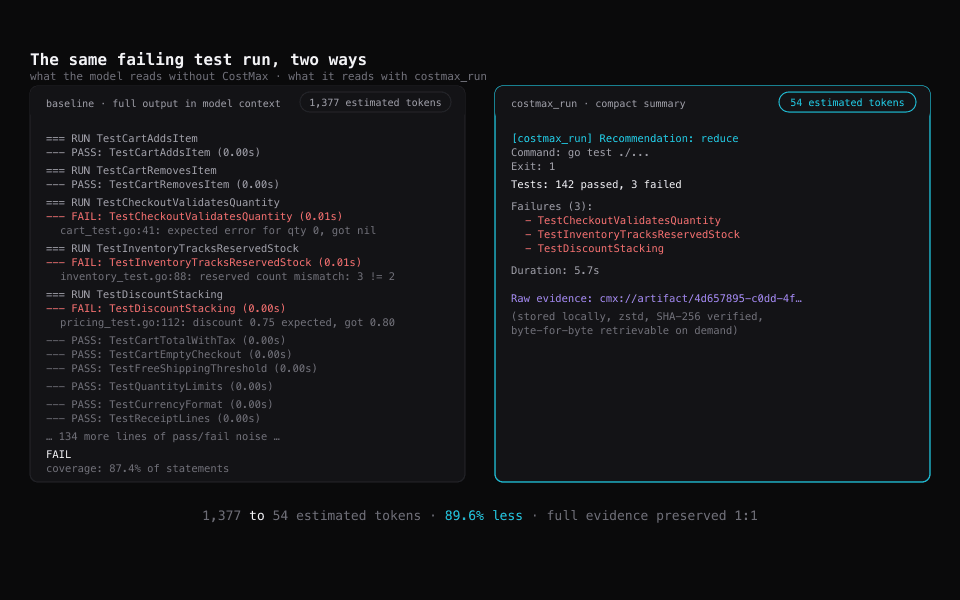
A failing test run can spend 1,377 tokens to say three tests failed. CostMaxx keeps the signal and stores the rest. The left panel is what the model would have seen; the right panel is what it needs.
A smaller answer, same evidence
The model sees a compact summary: command, exit code, counts, failing names, duration. Raw output stays local, zstd-compressed and content-addressed, so it can be retrieved without being re-run.
Local by design
Hooks observe; the model calls the tool explicitly. Reduction is deterministic, with no model in the loop. Same command, same output, same compact summary.
Measured, not asserted
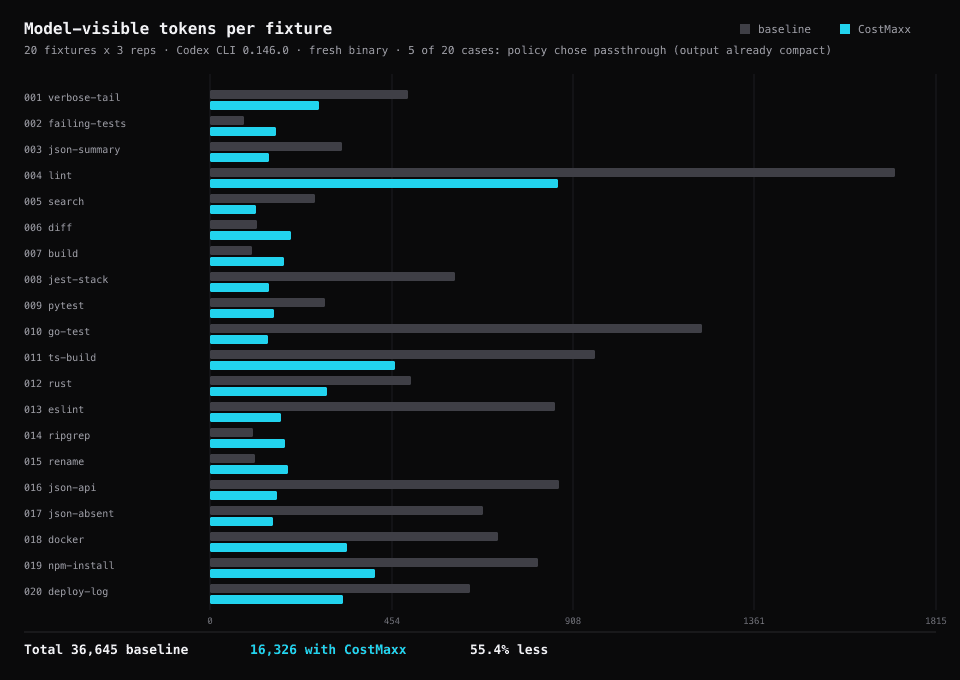
A 20-fixture, three-repetition evaluation reports 55.4% less model-visible output while retaining all 60 answer signals. The control arm is reported honestly: savings come from real command output, not from dropping evidence.
What it does not do
It is not a sandbox and it does not compress interactive, destructive, or secret-sensitive commands. It runs with the permissions of the process that calls it. The next step is support beyond Codex and a wider reduction catalog.